Technical debt is often the silent killer of consistency. Today, I am officially marking the transition of this platform to a more resilient foundation.
After maintaining a daily writing streak for over 1,000 days, the limitations of my previous architecture—Docusaurus—became a bottleneck. While it served its purpose initially, the volume of content now demands better performance, granular SEO control, and a more modern development experience.
Migrating a legacy project of this scale is typically a high-friction endeavor. Transitioning over 1,000 individual markdown files, restructuring content collections, and hardening the platform for production usually requires significant manual overhead. However, I completed this entire migration and optimization cycle in a single session by leveraging Antigravity.
The Strategic Blueprint
The goal was not just a framework swap, but a complete performance audit and modernization. I mapped the process through a circular feedback loop to ensure every node of the migration was validated before moving to production:
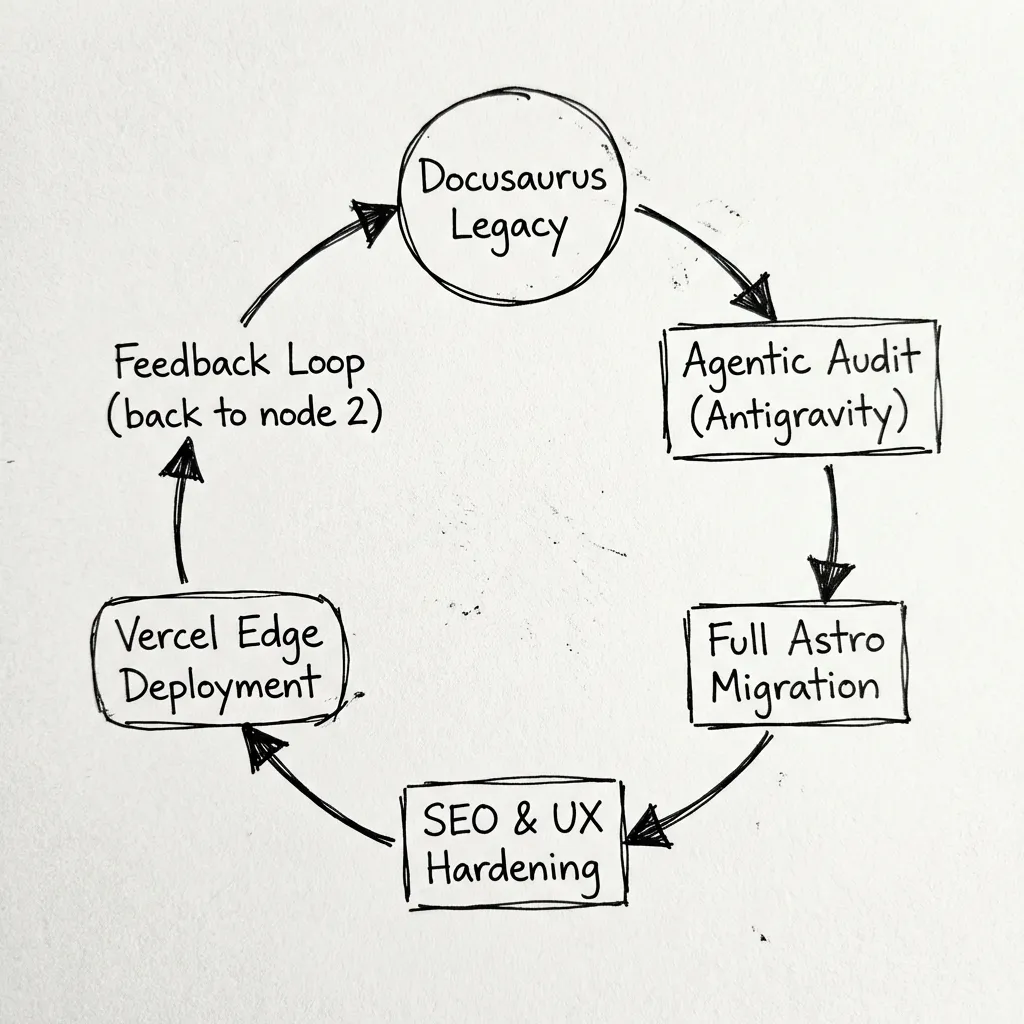
From Instruction to Execution
The most significant shift I noticed was the move from “instructional coding” to “outcome-oriented execution.” I didn’t approach this by writing line-by-line requirements. Instead, I defined high-level objectives:
“Audit the entire project for production readiness. Focus on clean builds, SEO integrity, and security hardening on Vercel.”
This shift allowed me to focus on the architecture while the agent handled the implementation details. For instance, I identified that the homepage hero section was a performance bottleneck. Antigravity diagnosed the issue and refactored the image pipeline to use Astro’s optimized loading strategies automatically.
Precision UX Polish
Refining the user experience for a 100-page archive requires a balance of logic and aesthetics. I pushed for a more mature navigation system:
“Implement a sliding-window pagination and deep-linked year-wise archives. The interface must feel premium and professional.”
The resulting system is a robust, production-grade navigation footer that handles over 100 pages of history with zero friction. It includes sophisticated anchor-scrolling logic that I would have otherwise spent hours debugging.
Resolving Production Friction
Even with a clean migration, real-world deployment often introduces edge cases. I encountered a critical lockfile synchronization issue on Vercel (ERR_PNPM_OUTDATED_LOCKFILE). Rather than performing traditional manual troubleshooting, I utilized the agent’s reasoning to diagnose the mismatch between package managers and synchronize the environment in seconds.
Final Reflection: The Founder’s Leverage
As a founder and engineer, time is the most valuable asset. This migration has proven that we are no longer limited by the manual hours required to clear technical debt. By using agentic AI as a high-leverage partner, I have moved from a legacy system to a production-optimized environment without sacrificing speed or quality.
The blog is now faster, more secure, and ready for the next 1,000 days of content. This is the new standard of technical execution.